
Our brands / Secondary Nutrients / Green Sulfur
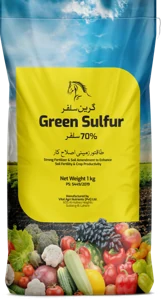
Green Sulfur
Sulfur 70% WDG
A nutrient that is never measured cannot appear deficient.
Punjab soil testing programme · 36 district workbooks · 770,160 valid samples · c. 2016–2018. The figure describes the soil. It is not a claim for the product.
Tell us the quantity and your district. We reply with price, availability and delivery. Every batch is tested in LAB 336, PNAC · ISO/IEC 17025:2017.
Specification
Drill it at sowing. Side-dress if you cannot. Broadcast last.
The same bag gives a different result depending on where it lands. The order below is VAN’s, for every basal granule it makes.
- 1 · bestDrill at sowing
What it means. The seed drill’s fertilizer box places the granule about 5 cm beside and below the seed row, never touching the seed.
Why. The root meets it first. Least contact with air, sun and free calcium at the surface. The whole bag is in the root zone.
- 2Side-dress
What it means. A band beside the row, by hand or planter, at sowing or the first irrigation, covered with soil.
Why. Still a band near the root, but later and shallower than a drill.
- 3 · lastBroadcast
What it means. Spread on the surface before the last ploughing or before an irrigation, and mixed in.
Why. Most of the bag is away from the root, and most of it is exposed at the surface.
Green Sulfur comes in 2 grades: a granule for the soil, which takes this order, and a water-dispersible powder for fertigation. Where the programme row says fertigation, use the powder and follow the row.
Programmes that use it
From the published wheat programme. Per acre. “1 bag” means 1 bag of the size printed under the rate.
| Crop | Stage | Band | Rate | Method | Pack |
|---|---|---|---|---|---|
| Wheat | Germination | Secondary Nutrient | 1 bag | Fertigation | Bag · 1 kg |
| Wheat | Early Growth | Secondary Nutrient | 1 bag | Fertigation | Bag · 1 kg |
Green Sulfur goes on both ways. It is broadcast at land preparation in some programmes and fertigated in others. Broadcasting gives elemental sulfur soil contact, and weeks for soil microbes to oxidise it into the sulfate a root can take up. The rate is crop-driven and ranges from about 2 kg an acre on wheat and the pulses to about 10 kg on cotton, maize, potato and garlic. That spread is deliberate. Your crop’s programme shows the method and the rate.
What it is, what it does in the soil, where it fits in the season and what VAN will not claim for it.