
VAN brands / Phosphorus / Fusion Phosphate
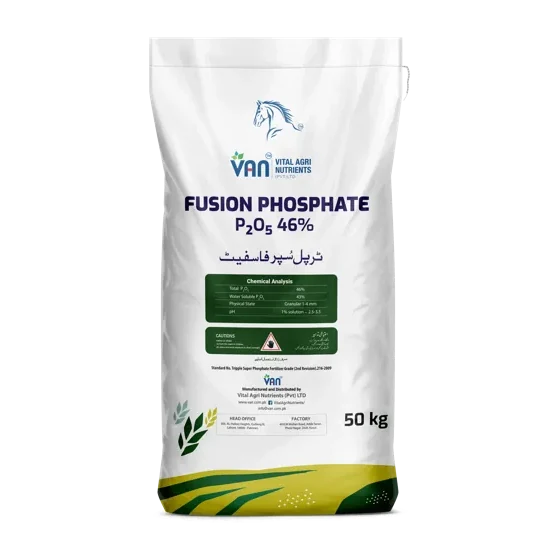
Fusion Phosphate
Triple superphosphate (TSP). P₂O₅ 46%
Fusion Phosphate supplies phosphorus. In Punjab soil tests from about 2016 to 2018, 97.9% of samples had less than 15 ppm of available phosphorus. A soil needs at least 15 ppm to be counted as adequate in phosphorus. The mean calcium carbonate (lime) content of the samples was 6.53%. These are historical measurements of Punjab’s soil, not results of Fusion Phosphate.
Punjab’s soil is calcareous, and its carbonate content is higher where the pH is higher. VAN’s phosphate range is designed for calcareous soil.
Source: Punjab soil testing programme, 770,160 valid samples from 36 districts.
In VAN’s crop plans, Fusion Phosphate and Green Phosphate are alternatives: where a plan names one of them for the phosphorus application, you can use the other instead.
Both products come in a 50 kg bag, and Green Phosphate also comes in 35 kg. They contain different amounts of phosphate and nitrogen. Fusion Phosphate is TSP (triple superphosphate) at 46% P₂O₅: a 50 kg bag carries 23 kg of P₂O₅ and no nitrogen. A 50 kg bag of Green Phosphate (6:32:0) carries 16 kg of P₂O₅ and 3.0 kg of nitrogen. Green Phosphate is the humic-coated, acidic 6:32 grade of the VAN NP Range, made for alkaline soil. If you switch, the plan’s number of bags stays the same, but the amount of phosphate and nitrogen you apply changes.
Send the quantity you need and your district on WhatsApp. VAN replies with the price, whether the product is available, and how it can be delivered.
Specification
Methods of soil application, in order of preference: drill at sowing, side-dress, broadcast
The crop’s response to the same amount of fertiliser depends on where the granules are placed. For granular fertilisers applied at or before sowing, VAN recommends these 3 methods in this order.
- 1 · preferredDrill at sowing
What it means. The seed drill’s fertiliser box places the granule about 5 cm beside and below the seed row, never touching the seed.
Why. Roots reach a drilled granule sooner than a granule placed by side-dressing or broadcasting. Of the 3 methods, drilling leaves the granule with the least contact with air, sunlight and the free calcium at the soil surface, and it places all of the fertiliser in the root zone.
- 2 · second choiceSide-dress
What it means. The granules are placed in a band beside the row, by hand or with a planter, at sowing or at the first irrigation, and covered with soil.
Why. The band is still close to the root, but it is placed less deep than a drilled granule, and it may be applied later, at the first irrigation.
- 3 · least preferredBroadcast
What it means. The granules are spread over the field surface before the last ploughing or before an irrigation, and mixed into the soil.
Why. Most of the fertiliser ends up away from the root, and most of it stays near the soil surface.
Crop plans that use Fusion Phosphate
The crop plans show which crops use Fusion Phosphate and at which stage. The wheat plan names Green Phosphate for the phosphorus application. You can use Fusion Phosphate in its place, as explained above. Open the crop plans →
These documents explain what the product is, how it works, when in the season it is used and the limits on its use.