
Our brands / Phosphorus / Green Phosphate
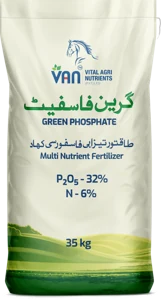
Green Phosphate
6-32-0 · humic-coated acidic. The NP Range 6-32 grade
Green Phosphate and Fusion Phosphate are both offered against the phosphorus line in every programme that names one of them. The plan's number of bags is the same either way; what goes on the field is not.
Same bag size, different bag. Fusion Phosphate is TSP at 46% P₂O₅. About 44% more phosphate per bag than Green Phosphate’s 6-32-0, and no nitrogen with it. Green Phosphate is the humic-coated acidic grade, built for alkaline ground. The plan’s number of bags does not change if you switch; what you put on the field does.
Calcareous soil, carbonate rising with pH. The condition the phosphate range is built against.
Punjab soil testing programme · 36 district workbooks · 770,160 valid samples · c. 2016–2018. The figure describes the soil. It is not a claim for the product.
Tell us the quantity and your district. We reply with price, availability and delivery. Every batch is tested in LAB 336, PNAC · ISO/IEC 17025:2017.
Specification
A bag of DAP every year and the soil test still says phosphorus is low. Where does it go?
Calcareous soil takes the phosphate back
In soil above pH 8 with free lime, phosphate dissolving out of a granule meets calcium within a few centimetres and drops out of solution. The first calcium phosphates are still fairly available; the loss is their slow ageing into rock-like forms the root cannot use. 35 of 36 Punjab districts read Critical or Weak on phosphorus.
The granule carries its own acidic zone
Green Phosphate is granulated in an acidic mix and sealed with humic, with a fraction of fulvic. The zone around each granule starts acidic, the opposite of a DAP granule, which slows the calcium reaction for the weeks a root needs to reach it. A microsite effect, a few centimetres wide. It will not move a soil test.
Do not compare kilograms; compare what reaches the crop
A 50 kg bag of DAP carries more phosphate than a 50 kg bag of Green Phosphate. What the crop eats is what stays available, and on calcareous ground that is the smaller number by far. The humic seal, with a fraction of fulvic, feeds the soil and the root: across 81 published studies humic raised shoot and root growth, and Pakistani calcareous-soil trials found the consistent gain came from organic matter applied with the phosphate (Rose et al. 2014, Advances in Agronomy 124; Ahmad et al. 2022; Mussarat et al. 2021; Mehdi et al. 2003). VAN makes phosphate to be available, and that is the comparison that matters.
Pick your district and the page reads the Punjab survey’s median for it. A district median is not your field.
1 bag of 50 kg carries 16 kg P₂O₅ and 3.0 kg N, from the declared 6-32-0. The same 50 kg of TSP carries 23 kg P₂O₅ and no nitrogen, and no coating. On the crop page you can switch between them; the plan’s bag count does not change on a switch, on purpose.
- That 70 to 80% of applied phosphate is fixed. That was a recovery statistic misread as soil chemistry, and it is off the site.
- That it beats DAP or TSP by source alone. The Pakistani field trials do not support that for any source.
- A field-scale pH change, a soil-test change, or a percentage of phosphate saved.
- A replicated independent field trial. None exists yet.
Drill it at sowing. Side-dress if you cannot. Broadcast last.
The same bag gives a different result depending on where it lands. The order below is VAN’s, for every basal granule it makes.
- 1 · bestDrill at sowing
What it means. The seed drill’s fertilizer box places the granule about 5 cm beside and below the seed row, never touching the seed.
Why. The root meets it first. Least contact with air, sun and free calcium at the surface. The whole bag is in the root zone.
- 2Side-dress
What it means. A band beside the row, by hand or planter, at sowing or the first irrigation, covered with soil.
Why. Still a band near the root, but later and shallower than a drill.
- 3 · lastBroadcast
What it means. Spread on the surface before the last ploughing or before an irrigation, and mixed in.
Why. Most of the bag is away from the root, and most of it is exposed at the surface.
Programmes that use it
From the published wheat programme. Per acre. “1 bag” means 1 bag of the size printed under the rate.
| Crop | Stage | Band | Rate | Method | Pack |
|---|---|---|---|---|---|
| Wheat | Land Preparation | Phosphorus | 1 bag | Drill at sowing; broadcast if no drill | Bag · 50 kg |
Green Phosphate is the NP Range 6-32 grade. Humic-coated and acidic, engineered against calcium fixation. The VAN NP Range →
What it is, what it does in the soil, where it fits in the season and what VAN will not claim for it.